Hotels & restaurants
Olive oil bottle engraved with your logo: a guide for hotels, restaurants and beach clubs
Laser engraving, how it differs from labels and screen printing, table service rules: what you need to know before putting your logo on your olive oil bottles.
Adapted from the French edition updated on 24 October 2026
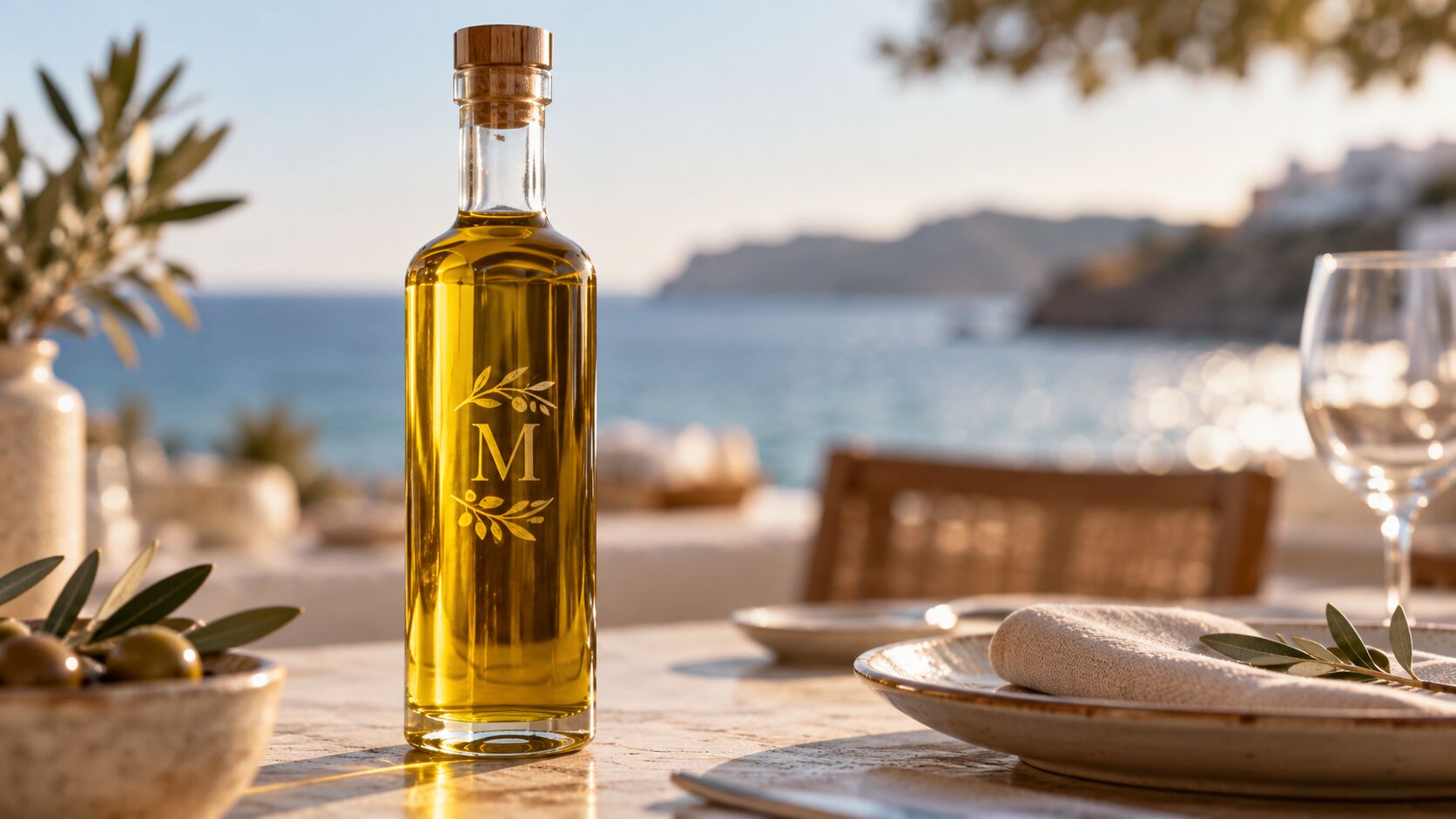
An olive oil bottle engraved with your logo is a glass bottle marked permanently by laser, with no ink or label. For a hotel, a restaurant or a beach club, it personalises table service with an understated look.
Unlike an engraved bottle given as a gift, a service bottle stays in your establishment. And the container is not everything: the oil inside matters as much as the logo. Here is how laser engraving works, how it differs from a label or screen printing, and what to prepare for your project.
In short
- The technique: laser engraving, a mark in the surface of the glass, with no ink or glue.
- The benefit: a logo that is part of the glass and does not peel off.
- How it works: two solutions depending on the applicable regulations and the quantities, a bottle refilled by your teams or bottles filled with your logo.
- What you need first: your logo as a vector file.
- The contents: an oil you can name on the menu.
Engraving, label, screen printing: what are the differences?
There are three main ways to put your logo on a bottle:
| Label | Screen printing | Laser engraving | |
|---|---|---|---|
| Principle | Paper or film, glued on | Ink applied to the glass | Mark in the surface of the glass |
| Colours | Any | One or several | A single frosted white finish |
| Resistance to washing | Low to medium | Good | The mark is part of the glass |
| Best use | Bottle sold or given | Large runs | Reused service bottle |
A label remains the best solution for a bottle that goes home with the client: a gift, a shop, resale. Screen printing is mainly for large runs. For a bottle that stays in your establishment and travels hundreds of times between the kitchen, the dishwasher and the dining room, laser engraving is the most durable. The choice therefore depends first on the use: serving oil at the table, selling a bottle or personalising a range.
Why laser engraving suits table service
- It does not peel off. The logo is part of the glass: unlike a label, it does not come off or wrinkle with humidity.
- It is understated. The frosted, tone-on-tone finish suits a pared-back setting, from a fine-dining restaurant to a beach club.
- No ink or glue. No glue residue on the bottle, no ink to damage.
- It lasts. An engraved bottle can be used from one season to the next, depending on its condition and your hygiene procedures, whereas a damaged label means replacing the bottle.
Two solutions, depending on the applicable regulations
The rules on olive oil containers served at the table are not the same in every European country: some require labelled, non-refillable bottles in restaurants. The EU framework (Delegated Regulation (EU) 2022/2104) governs packaging: a container of 5 litres maximum, a closure that can no longer be sealed after first opening, full labelling, with possible adjustments for the catering sector. The use of a refillable service container then falls under each country's rules. The solution is therefore chosen at the quotation stage, according to the regulations that apply to your establishment and your quantities:
- The refillable service bottle: a glass bottle laser-engraved with your logo, refilled by your teams from Biolivio tins. The original, labelled tin keeps the mandatory information and the batch number of the oil served. The bottle is invoiced in addition to the oil.
- Personalised bottles filled directly: bottles with your logo, filled and packed on the island of Crete, for larger projects. Their labelling carries the mandatory information: name, origin, net quantity, batch number, best-before date, operator and nutrition declaration.
Using a refillable service bottle well
The system combines two formats: tins for the kitchen and for refilling, engraved bottles in the dining room. To keep the oil at its best:
- Empty, wash and dry the bottle completely before refilling it, following your hygiene procedures, rather than topping up oil that has already been opened.
- Fill quantities matched to your usage, so that the oil does not stay too long in contact with air.
- Keep the bottles away from light and heat between services, and never in direct sunlight on the terrace, especially with clear glass, which shows the colour of the oil. The French trade magazine L'Hôtellerie Restauration also recommends a small format for the dining room (article in French).
- Note the batch number of the tin in use: it identifies the oil served.
A beautiful bottle, an oil you can name
An engraved bottle draws attention to what it contains: the guest notices it, tastes it, and sometimes asks which oil is being served. With an oil of identified origin, your team has a precise answer, and you can write it on the menu: “Organic extra virgin olive oil, PDO Messara, Crete, 100% Koroneiki”.
That is the point of entrusting the bottle and the oil to the same partner: the logo on the glass and the origin in the bottle tell the same story. To choose the oil itself, see our guide choosing olive oil for a restaurant or a hotel.
What to prepare for the engraving
- Your logo as a vector file (AI, EPS, PDF or SVG). Engraving is single-colour: a simple logo, without gradients or very fine detail, works best.
- A short text if needed: name of the establishment, town, year founded.
- The number of bottles: plan for your dining room stock, plus a margin for breakage and extra bottles for the high season.
Before the engraving starts, a test is made on one bottle and a photo of the result is sent to you: nothing goes ahead without your approval.
The engraved bottle within the Biolivio Studio
The engraved bottle fits with the Studio's other services:
- In the dining room: bottles engraved with your logo.
- In the kitchen: tins of the same oil.
- In the shop, the rooms or as a gift: a Your Brand × Biolivio label from 100 litres, or private label from 300 litres, subject to review, where your brand becomes the commercial signature of the product, subject to the mandatory regulatory information. A gift box in your colours is available as an option, on quotation.
The oil is the same everywhere: extra virgin, organic, PDO Messara, 100% Koroneiki, hand harvested, cold extracted, by mechanical means only, below 27 °C, on the day of harvest, with an acidity well below the 0.8% standard. It is made on the island of Crete and bottled to order. See the details on the Studio page.
Frequently asked questions
Can any logo be engraved on an olive oil bottle?
Most logos engrave well, provided there is a vector file. A very detailed or gradient logo can be simplified for engraving: the test bottle, sent as a photo, lets you approve the result.
Can an olive oil bottle be refilled in a restaurant?
It depends on the regulations that apply to your establishment. Depending on the case, we offer an engraved bottle refilled from our tins or bottles with your logo filled directly.
Is the engraved bottle included in the price of the oil?
No: the engraved bottle is invoiced in addition to the oil. The quantity and lead time depend on your project and are stated in the quote.
Is the oil supplied with the bottles?
Yes: Biolivio supplies both the organic PDO oil and the engraved bottles, with a single point of contact.
Would you like a bottle with your logo on your tables? Describe your project: number of covers, formats and logo. We will come back to you with a quote, and a test photo is sent to you before engraving.
Your logo on your tables.
Send us your logo, the number of covers and the formats you would like. A test photo is sent to you before engraving.
Request a quote