
Beach clubs
Beach clubs: choosing, storing and presenting olive oil
Choosing your beach club's olive oil, protecting it from sun and heat, and presenting it on the menu and at the table.
Adapted from the French edition updated on 24 October 2026
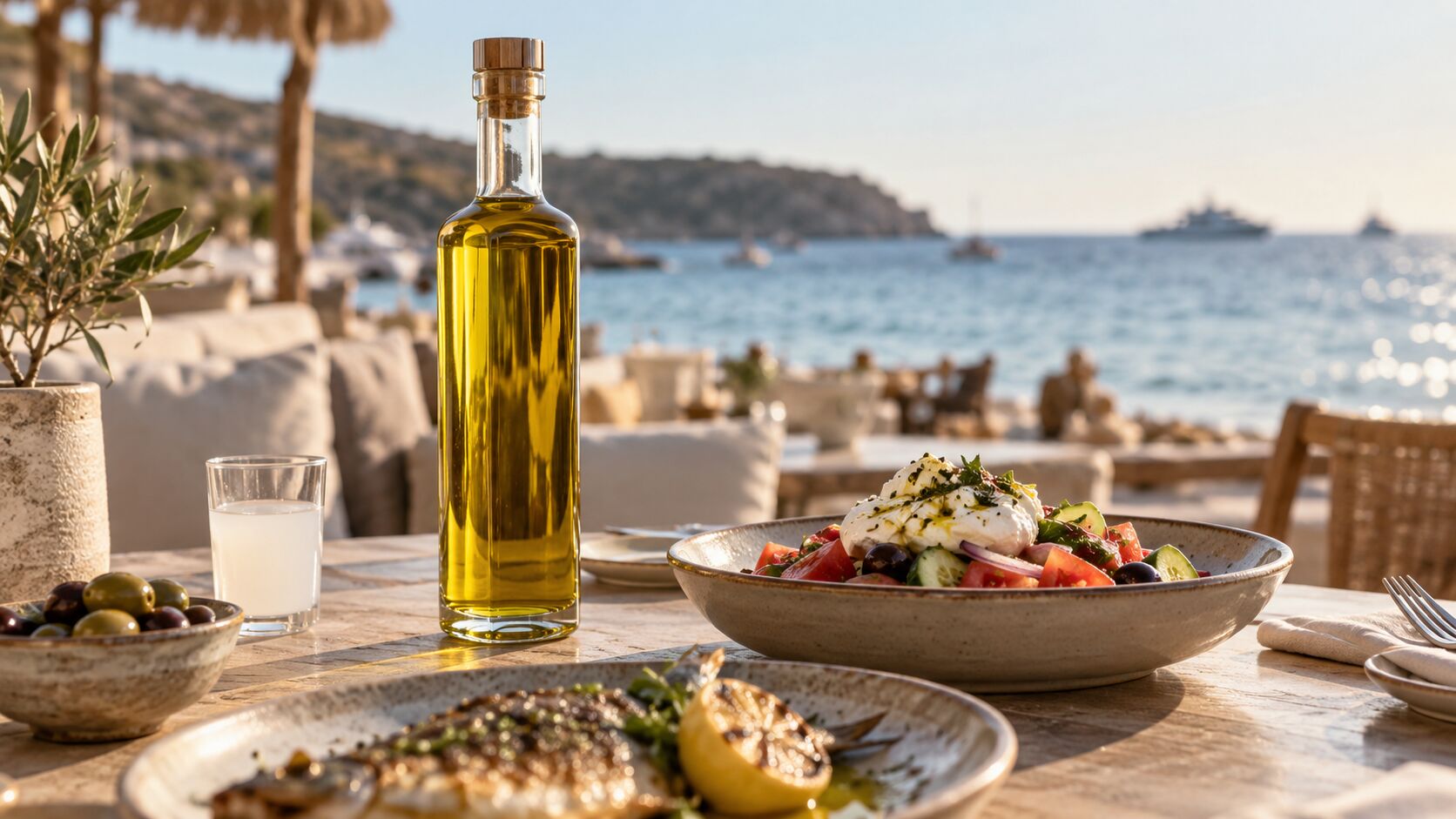
To choose the olive oil for a beach club, go for an extra virgin oil of identified origin, then protect it from heat, light and air. By the sea, storage matters as much as the choice of oil: sun, heat and salt air.
From grilled fish to burrata, and bread to share, olive oil comes with the dishes your guests taste most directly. This guide helps you make the right choices at the table, in the kitchen and in the storeroom. To go straight to formats and personalisation, see our olive oil offer for beach clubs.
In short
- The choice: an extra virgin olive oil of identified origin, ideally PDO, organic if your menu highlights it.
- At the table: small formats, in tinted or clear glass, never in direct sunlight.
- In the kitchen: a large format matched to your kitchen team's consumption.
- In the storeroom: a cool, dark room, and volumes matched to your usage.
- In your name: a bottle engraved with your logo or a label in your identity.
Why olive oil matters more in a beach club than elsewhere
Grilled fish, carpaccio, burrata, salads, plancha vegetables, bread to share: a beach club menu gives pride of place to Mediterranean cooking. On these dishes, olive oil is not just for cooking: it is used as a finish, just before serving. A flat or oxidised oil shows immediately on raw fish or a tomato.
The table itself is a showcase. Between the bottle in the centre, the waiter dressing a dish in front of the guest and the photos shared on social media, olive oil is part of the experience you sell.
Criteria for choosing a beach club's olive oil
The extra virgin category. EU regulations set a maximum free acidity of 0.8% for this category, with a sensory analysis free of defects and a perceptible fruitiness (Delegated Regulation (EU) 2022/2104). This is the level to require for an oil served raw.
An identified origin. A PDO (protected designation of origin) guarantees a controlled area and specification. On a menu, “PDO Messara olive oil, Crete” tells a story; “olive oil” tells nothing.
A clear variety. A single-variety oil, such as 100% Koroneiki, has an aromatic identity that your chef can describe and pair with dishes. As with wine, its profile changes from one harvest to the next: have your team taste each new harvest.
Organic, if your menu highlights it. A certified organic oil lets you showcase this way of farming to guests who care about it.
To go deeper into these criteria, see our guide to choosing olive oil for a restaurant or a hotel.
At the table: the bottle your guests see
This is the most exposed format, and the most visible.
- A small format, in tinted or clear glass. The French trade magazine L'Hôtellerie Restauration recommends a 250 or 500 ml bottle, preferably opaque (article in French) for the dining room, easier to place on every table. Clear glass has another advantage: it shows the colour of the oil, a lovely touch on the table. It just needs more care: never direct sunlight on the bottle, and small refills.
- In the shade between services. A bottle left in full sun on an empty table deteriorates much faster than one in the shade: bring it in between services.
- Closed after every use, to limit contact with air.
Name the oil on the menu. It is the simplest step and the one most often missed. State the origin, the variety, the designation and the farming method: for example “Organic extra virgin olive oil, PDO Messara, Crete, 100% Koroneiki”. Your team can then answer simply when a guest asks about the oil served.
Serve it on arrival. A small dish of oil with the bread, in white porcelain that brings out its colour, turns a basic product into the first tasting moment.
A bottle with your logo. A laser-engraved glass bottle stays immaculate all season: unlike a paper label, engraving does not peel off with humidity. Two solutions are possible depending on the applicable regulations and the quantities: a service bottle refilled by your teams from Biolivio tins, or bottles with your logo filled directly. The details are in our article on the olive oil bottle engraved with your logo.
In the kitchen: the large format
For the kitchen team, a tin is the most practical and economical format. The choice between 1, 3 or 5 litres depends on your consumption and the size of the team: better a tin that empties quickly than a large container left open too long.
A quality extra virgin oil works as well for gentle cooking as for finishing, which avoids managing two products. Some chefs prefer to keep their best oil for raw dishes and use another oil for high-temperature cooking: that is a menu and budget choice.
In the storeroom: protecting the oil from heat
Olive oil has three enemies: light, heat and air. A beach club brings all three together.
- A cool, dark room. L'Hôtellerie Restauration recommends storage at around 10 to 12 °C, never below 8 °C. On a beach, the ideal room does not always exist: choose the coolest, away from the sun and the heat sources of the kitchen.
- Fast rotation. Once opened, a bottle is best used within three months. Order volumes matched to your usage rather than a large stock at the start of the season.
- An oil that has not been waiting. An oil bottled to order has not spent long months in a warehouse as bottles prepared in advance.
Putting your name on the oil
Beyond the table bottle, the Biolivio Studio offers three levels to associate your venue with the oil:
- Buy Biolivio: the oil carries our brand, with a card bearing your message if you wish, from 50 litres.
- Your Brand × Biolivio: your brand appears alongside Biolivio on the label, from 100 litres, about 200 bottles of 50 cl.
- Private label: your brand becomes the commercial signature of the product, subject to the mandatory regulatory information, from 300 litres, subject to review.
A bottle to take home or a gift box for your regular guests extends the experience beyond the season. A gift box in your colours is available as an option, on quotation.
In every case, the oil is the same: extra virgin, organic, PDO Messara, 100% Koroneiki, hand harvested, cold extracted, by mechanical means only, below 27 °C, on the day of harvest, with an acidity well below the 0.8% standard. It is made on the island of Crete and bottled to order. Not every format can be personalised: the quote tells you which. The three levels are detailed on the Studio page.
Preparing the season
A beach club's business is concentrated over a few months. Because the oil is bottled to order, and personalisation needs an approval step, the project is prepared before opening:
- Off season: a 25 cl sample bottle, sent once we have reviewed your project, a tasting with the chef, the choice of formats and an estimate of volumes.
- Before opening: approval of the personalisation (label or engraving), then the first order.
- During the season: depending on the total volume, several deliveries can be scheduled. They are set out in the commercial proposal.
The lead time depends on the personalisation and the time of year: it is stated in the quote. We deliver to mainland France and the French West Indies, Belgium, Switzerland and Luxembourg, other countries on request. Depending on the project, logistics are offered as a flat fee or an all-inclusive price.
Beach clubs in the French West Indies
In Guadeloupe, Martinique, Saint Martin and Saint Barthélemy, distance changes the preparation. The oil leaves the island of Crete as a grouped shipment, from 500 litres, or combined with another venue's order. Transport and import formalities are prepared well before high season: the lead time, the applicable taxes and the logistics cost are set out in the quote. All the terms are on our page olive oil for professionals in the French West Indies.
In a tropical climate, storage matters even more: a cool, dark storeroom, small formats out of direct sunlight at the table and volumes matched to your usage until the next shipment. See also our guide organic olive oil supplier in the Caribbean.
Frequently asked questions
Which olive oil should a beach club choose?
An extra virgin olive oil of identified origin, ideally PDO, organic if your menu highlights it. A single-variety oil also lets your team present a precise origin and aromatic profile.
How do you store olive oil by the sea?
Away from sun and heat: never direct sunlight on table bottles, a cool, dark room for large formats, bottles closed after every use and volumes matched to your usage.
Which format should go on the tables?
A small format, 25 or 50 cl, in tinted glass, or clear glass to show the colour of the oil, kept out of direct sunlight. A bottle engraved with your logo personalises the service and can be refilled where the applicable regulations allow.
Can we have an olive oil in our beach club's name?
Yes: a bottle engraved with your logo, a Your Brand × Biolivio label from 100 litres, or private label from 300 litres, subject to review.
Do you deliver to beach clubs in the French West Indies?
Yes: in Guadeloupe, Martinique, Saint Martin and Saint Barthélemy, as a grouped shipment from 500 litres, or combined with another venue's order. Lead time, taxes and logistics are set out in the quote.
Can we taste the oil before ordering?
Yes: a 25 cl sample bottle can be sent once we have reviewed your project, so that your chef can judge the oil on the nose and palate.
Preparing your beach club's opening or next season? See our offer for beach clubs or tell us about your project: formats, estimated volumes and the personalisation you would like.
Get ready for your season.
A 25 cl sample bottle, then a quote based on your formats, your volumes and the personalisation you would like.
Request a quote